Essays · 6 min read ·
AI vs Human College Essay Review: Which Should You Use?
AI vs human college essay review: what each is good at, what each misses, how much they cost, and a simple plan for using both before you submit.
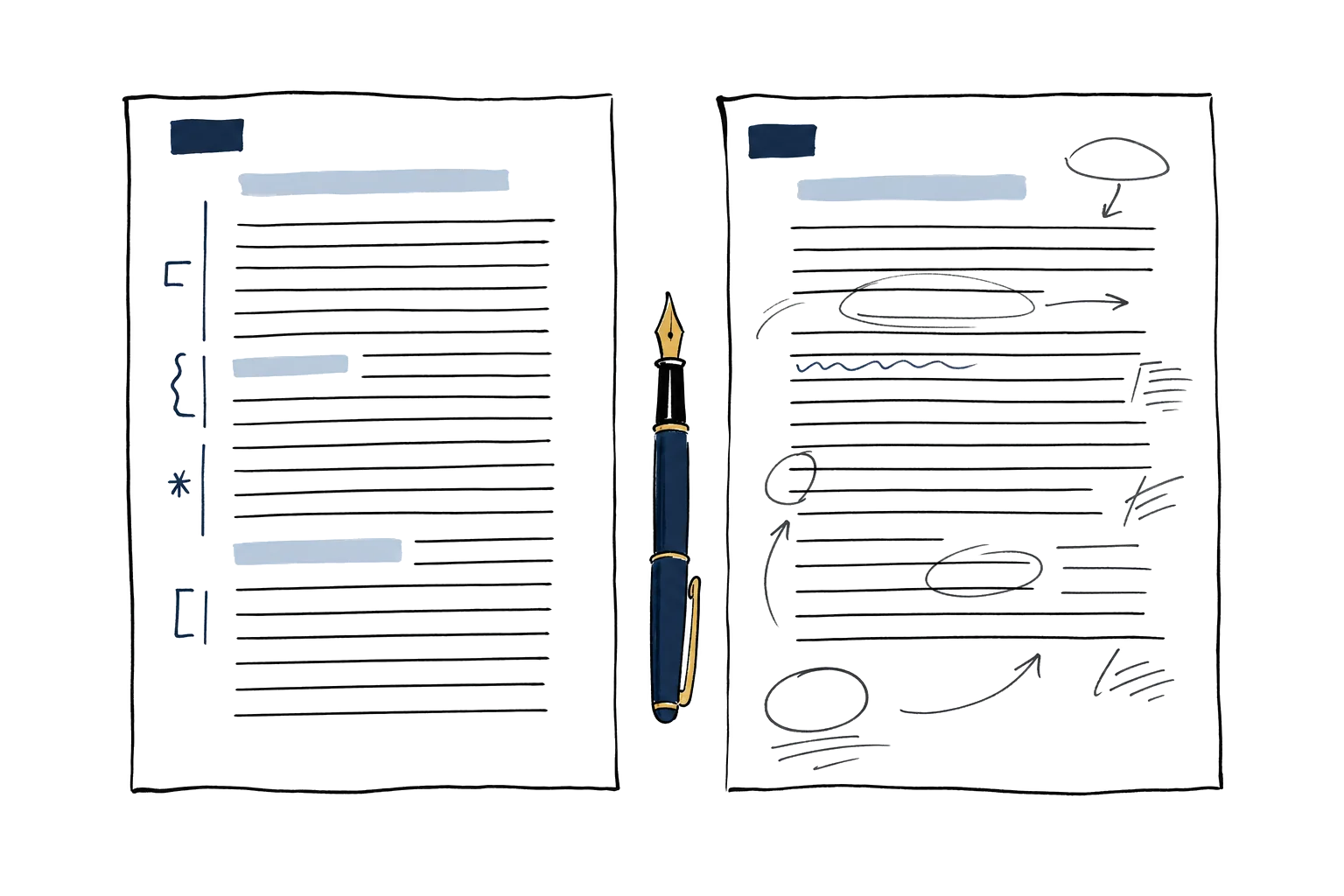
In the AI vs human college essay review debate, the honest answer is that they're good at different things. AI review is instant, consistent and cheap, which makes it ideal while you're drafting. A good human reader knows you, and that makes them irreplaceable before you submit. Most strong essays get both.
What AI essay review does well
- Speed. You get feedback in seconds, at 11 p.m., on your sixth draft. That makes it easy to revise in small steps.
- Consistency. A rubric-based grader scores the same draft the same way every time, so you can tell whether a change helped. (Chatbots without a fixed rubric don't; see how AI essay graders work.)
- Patterns readers notice. Slow openings, summary instead of scenes, a missing "so what," sentences that say the same thing twice.
- No social cost. It's easier to share a rough draft with software than with your English teacher.
- Price. Our essay grader is free for 3 essays a day.
What a human reviewer does better
- They know you. A counselor who's watched you for three years can tell you the essay is about the wrong thing, or that your best story is the one you left out.
- Voice. People are better at hearing whether an essay sounds like a real 17-year-old, and like you specifically.
- The whole application. A counselor can see whether your essay repeats your activities list or fills a gap in it.
- Judgment calls. Whether a topic is too personal, whether a joke lands, whether a school will read a line the way you mean it.
Where each one falls short
| AI review | Human review | |
|---|---|---|
| Speed | Seconds | Days to weeks |
| Cost | Free to a few dollars a month | Free to hundreds of dollars |
| Consistency | High with a fixed rubric | Varies by reader and mood |
| Knows your story | Only what's on the page | Often, if they know you |
| Risk | Generic suggestions, invented praise | Over-editing your voice away |
Both have a failure mode worth naming. AI can be confidently generic. Human editors, especially well-meaning parents, can rewrite an essay until it sounds like a 45-year-old. Whoever reads your essay, the words should stay yours.
A simple plan that uses both
- Draft freely. Get a complete version down without asking anyone.
- AI rounds while you revise. Grade the draft, fix the weakest dimension, grade again. Repeat until the scores stop moving. For supplements, use your school's grader, such as the Yale essay grader, so it checks the exact prompt.
- One human read for substance. Ask: "What do you learn about me? What's missing?" Not "Can you fix my commas?"
- Revise again, then a final proofread. A last AI pass for clarity and a human pass for typos.
Two or three trusted readers is plenty. Past that, essays tend to get safer and flatter.
Questions to ask any reviewer, AI or human
- What's the one idea this essay is about?
- Where did you lose interest?
- Which line sounds most like me? Which sounds least like me?
- What do you want to know more about?
- If you cut one paragraph, which would it be?
If a reviewer can't answer the first question in a sentence, your theme needs work, whatever the grammar looks like.
Comparing tools? See Admit Coach vs ChatGPT, then paste your draft into the free college essay grader.
Frequently asked questions
For some things, yes: spotting a slow opening, vague summary, missing reflection or wordy sentences, instantly and consistently. A thoughtful human reader is better at judging whether the story is the right one, whether it sounds like you, and how it fits the rest of your application. Use AI for fast drafts and a person for the final read.
It ranges from free (a teacher, school counselor or friend) to hundreds of dollars for private consultants, who often charge by the hour or by the essay. AI graders are free or cost a few dollars a month.
One or two people who know you and will be honest, such as an English teacher, your school counselor or a mentor. Too many readers pull an essay in different directions and can sand the voice out of it.
AI review is fine and widely used. The line to watch is authorship: get feedback, then make every change yourself in your own words. Don't submit sentences an AI wrote.
Get honest feedback on your essay
Six scores against an admissions rubric, quotes from your draft as evidence, and the one fix to make next. Free, no account needed.
Keep reading
Essays · 6 min read
Can Colleges Tell If You Used AI on Your Essay?
AI detectors are unreliable, but that isn't the point. AI-written essays tend to read as generic, policies treat them as misrepresentation, and the safe uses of AI are easy to stay within.
Essays · 7 min read
How AI College Essay Graders Work (and What They Can't Do)
An AI essay grader is a language model plus a rubric, rules and checks. Here's what happens when you paste a draft, why some tools give you a different grade every time, and what no grader can tell you.

Essays · 7 min read
How to Use AI on Your College Essay Without Sounding Like AI
Use AI for feedback, questions and brainstorming, and keep every sentence your own. Here's what AI writing sounds like, why readers notice, and a process that keeps your voice.